
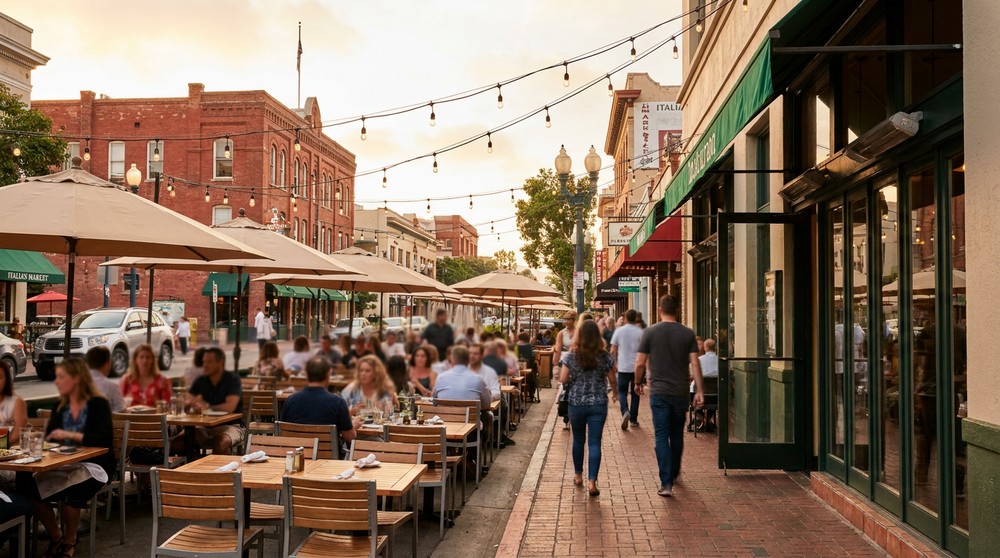
 Little Italy is competitive — and that’s not the whole problem
Formula Marketing works with hospitality brands across San Diego, from Gaslamp Quarter to Coronado to North Park. Little Italy is one of the markets we watch closely, because it’s one of the city’s most walkable, most photographed, and most food-forward neighborhoods — and still, restaurants there regularly leave Saturday night covers on the table. The competition is real, but it’s rarely the whole story.
The restaurants filling their dining rooms every Saturday share something beyond good food. They have marketing systems that work — specifically on the days and times that matter most. The ones struggling often have the same five fixable gaps. Here’s where to start.
Problem 1: Your Google Business Profile isn’t pulling weekend traffic
Most restaurant owners set up a Google Business Profile and forget it. But GBP is the first thing a potential Saturday-night diner sees when they search “Little Italy restaurants” or “Italian food near me in San Diego.” If your photos are outdated, your hours are wrong, or your posts stopped six months ago, you’re losing visibility before anyone ever clicks your website.
Google favors active profiles. Restaurants posting weekly updates, responding to reviews, and uploading fresh menu photos consistently outrank inactive competitors for local search terms. A 2023 BrightLocal study found that restaurants with complete, active GBP listings received 2.7 times more clicks than those with partial or inactive profiles. For a Little Italy restaurant, that gap is the difference between showing up in the top three local results and sitting on page two.
Problem 2: Social content is getting likes but not driving reservations
Content that performs well on Instagram — beautiful plating, ambiance shots, behind-the-scenes moments — doesn’t automatically translate into Saturday reservations. The gap is almost always the call to action. Posts that end with “Come visit us!” do far less than posts with a direct booking link, a specific table-availability window, or a promotion tied to a real deadline.
The platform mix also matters for restaurant marketing in San Diego’s Little Italy. TikTok trends toward younger, local discovery behavior; Instagram is stronger for aspirational dining and events. If your content strategy leans entirely on one or the other, you’re missing part of the local intent market that fills Saturday night tables.
Talk to Formula Marketing about a social strategy that connects content performance to reservation numbers — not just impressions.
Problem 3: No paid campaign targeting your highest-value nights
Organic reach has a ceiling. On a Thursday, when you’re trying to move inventory on a historically slow night, organic Instagram posts reach maybe 5–10% of your followers. Paid campaigns solve this by targeting the right audience at the exact moment they’re deciding where to eat. A $500–$1,000 Meta campaign running Thursday through Saturday, targeting high-intent diners in a 10-mile radius, will outperform a week of organic posts for driving actual covers.
The restaurants doing this well in Little Italy aren’t necessarily outspending their competitors. They’re concentrating budget around the nights where one turned table pays for the entire campaign. Formula Marketing’s restaurant consulting work is built around exactly this kind of night-specific, data-backed targeting.
Problem 4: Past visitors aren’t being brought back
Someone who dined with you six months ago and had a great experience is dramatically easier to convert than a cold prospect. Retargeting — showing ads to people who’ve already visited your website, opened your emails, or engaged with your social content — costs a fraction of prospecting and converts at a much higher rate. Most Little Italy restaurants don’t have this running at all.
A basic retargeting setup requires a Meta Pixel on your website, a list of past reservation contacts, and an audience of website visitors from the last 90–180 days. With those three inputs, you can run a consistent re-engagement campaign that brings regulars back and converts warm leads who checked your menu but never booked. It’s one of the highest-ROI moves in restaurant digital marketing, and it’s almost always the most overlooked one.
Problem 5: Review management is passive rather than active
The average San Diego diner reads 7–10 reviews before choosing a restaurant for Saturday night, according to a 2023 Podium Local Business Report. What they see in that read shapes the decision as much as the photos do. A restaurant with 4.2 stars and 80 reviews loses to a competitor with 4.6 stars and 400 reviews — even if the food is better — because volume and recency signal trustworthiness to both diners and Google’s local ranking algorithm.
Active review management means building a repeatable process to ask every satisfied guest for a Google review. It means responding to every review — positive and negative — within 48 hours. And it means flagging patterns in negative feedback that signal an operational issue before it compounds. This isn’t reputation monitoring. It’s reputation building, and it runs on systems, not hope.
Frequently asked questions about Little Italy restaurant marketing
How much should a Little Italy restaurant budget for marketing?
A realistic starting point for a single-location restaurant looking to move the needle is $3,000–$7,000 per month across agency fees and ad spend. That covers active GBP management, a social content calendar, targeted paid campaigns on the highest-value nights, and a basic retargeting setup. Larger restaurant groups or those with a launch coming up typically invest more, particularly around PR and influencer work tied to the opening window.
How long does it take to see results from restaurant marketing?
Paid campaigns produce the fastest results — usually visible in 4–6 weeks when targeting is set up correctly. Local SEO improvements, like GBP ranking gains and organic search visibility, take longer: 60–120 days for meaningful movement. The combination works best when paid tactics fill the short-term gap while organic and reputation-building compound in the background.
Is influencer marketing worth it for a Little Italy restaurant?
It depends on the goal. Micro-influencers in San Diego — accounts with 5,000–30,000 engaged local followers — are generally more cost-effective for driving actual reservations than large accounts with diluted audiences. A well-selected local food influencer whose audience skews San Diego residents will outperform a 200,000-follower LA-based account for your specific goal. Formula Marketing manages influencer work for several San Diego hospitality clients and can help identify the right fit.
What’s the single highest-impact thing a restaurant can do first?
Fix the Google Business Profile. It’s free, it’s visible to every potential diner searching for a Little Italy restaurant, and most profiles are incomplete or inactive. Update photos, verify hours, add menu items, and post weekly. Then respond to every existing review. These two actions alone will move your local search ranking within 30 days and cost nothing but time.
Where to start if Saturday night is the problem
Run an audit before you run a campaign. Look at where your Saturday reservations are actually coming from — Google, direct, OpenTable, referrals — and compare that breakdown against where you’re spending your marketing time and budget. In most cases, there’s a clear mismatch, and that mismatch is the gap worth closing first.
Formula Marketing works with Little Italy restaurants and hospitality brands across San Diego to build marketing strategies around real data, not guesswork. The results we’ve delivered for clients are built on exactly this kind of audit-first approach. If your Saturday covers aren’t where they should be, the answer is in the data — you just need someone to help you read it.
Ready to Get Started?
If Saturday night isn’t filling the way it should, the fix is usually simpler than you think — and faster than most restaurants expect once the right systems are in place.
Book a free strategy call or call us at (619) 955-8333.